
Table of contents
- Why grades matter for marine applications
- The most common marine plywood grades
- Comparing marine plywood grades at a glance
- How to select the right grade for your specific project
- Species matter when selecting grade
- Thickness and grade go hand-in-hand
- Common mistakes when choosing marine plywood
- Why CHANTA is a reliable supplier for marine plywood
- Final thoughts
When you start a boat-building project or plan a moisture-exposed construction, choosing the right grade of marine plywood becomes one of the most important decisions. The grade determines durability, water resistance, strength, and long-term stability. Many builders rely on marine plywood blindly without understanding differences between grades such as BS1088, BS6566, A-A, or A-B. Each grade works best in specific conditions, and selecting the wrong one can shorten the lifespan of the entire structure. This guide explains how to make the right decision and how materials like CHANTA Okoume marine plywood help you achieve reliable results.
Why grades matter for marine applications
Marine environments are harsh. Floors flex under load, hulls endure constant moisture, and every joint demands stability. Grades exist to guarantee predictable performance. A higher grade uses superior veneers, fewer repairs, stronger bonding, and stricter tolerances. That means less risk of hidden voids, delamination, or premature failure.
The grade determines how well the plywood will survive water, stress, and time.
The most common marine plywood grades
BS1088 – the premium standard for demanding marine construction
BS1088 marine plywood meets the highest international standard. Builders choose it for hull planking, structural flooring, and high-performance marine reinforcement because the standard ensures:
- Strictly no voids in veneers
- Balanced core construction
- Phenolic waterproof glue (WBP)
- Uniform density and excellent bending strength
Okoume BS1088 is especially popular for boats because it offers an excellent strength-to-weight ratio. CHANTA’s Okoume produced in Gabon meets this level and performs extremely well in epoxy-bonded or layered floor systems.
BS6566 – suitable for non-structural or secondary applications
BS6566 offers marine bonding quality but allows more repaired faces and slightly lower veneer quality. This grade works well for:
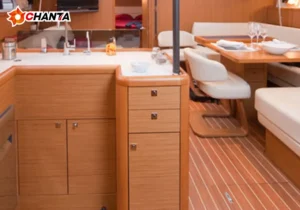
- Cabin interiors
- Bulkheads
- Non-critical flooring
- Furniture and trim inside boats
If you need cost savings without sacrificing waterproof bonding, BS6566 is a practical option.
A-A and A-B grades – appearance-oriented panels for visual surfaces
A-A and A-B surface grades refer to the face veneers. They can be marine-bonded or exterior-bonded depending on the specification. These grades fit applications where appearance matters:
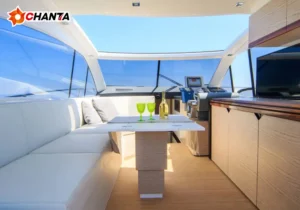
- Exposed boat interiors
- Decorative marine furniture
- Yacht paneling
Comparing marine plywood grades at a glance
| Grade | Quality Level | Best For |
|---|---|---|
| BS1088 | Very high — no voids, superior veneers | Boat hulls, marine floors, structural reinforcement |
| BS6566 | Medium-high — marine glue, some repairs allowed | Cabins, walls, non-structural areas |
| A-A / A-B | Appearance grade | Interiors, cabinetry, trim |
How to select the right grade for your specific project
Choose BS1088 for maximum durability
If your material will stay wet, experience loading, or be bonded with epoxy, BS1088 is worth the investment. Boats, exterior floors, docks, and reinforcement projects benefit from its structural reliability.
Select BS6566 for non-structural use
When weight and structure do not play a critical role, BS6566 offers adequate performance at a lower cost. It is commonly used for interior finishing.
Pick A-A or A-B when appearance matters
For visible surfaces such as yacht interiors, cabinet faces, or exposed panels, appearance-grade plywood creates a clean, premium finish.
Species matter when selecting grade
Okoume – lightweight and ideal for boats
Okoume marine plywood stands out for its excellent strength-to-weight ratio. It is perfect for small vessels, racing sailboats or layered floor systems.
Birch – heavy, strong, and extremely rigid
Birch delivers high screw-holding strength and stability. Commercial vessels and heavy-duty flooring often rely on birch marine plywood.
Meranti – balanced and cost-efficient
Meranti marine plywood suits general marine construction and long-term exterior reinforcement.
Thickness and grade go hand-in-hand
- 12–15 mm – suitable for small vessels or layered systems
- 18–25 mm – recommended for structural floors or heavy-duty reinforcement
Common mistakes when choosing marine plywood
- Using interior or non-marine plywood in wet environments
- Ignoring species differences
- Choosing incorrect thickness for the load
- Neglecting sealed edges or finish protection
Why CHANTA is a reliable supplier for marine plywood
CHANTA controls Okoume production in Gabon from log selection to core assembly, ensuring consistent veneer density and high bond strength. Contractors and boatbuilders trust CHANTA because the panels perform predictably in both structural and decorative marine applications.
- Factory-direct supply
- Stable volumes
- FSC certification available
- Custom thickness and size options
Explore CHANTA Marine Plywood Options
Final thoughts
Choosing the correct marine plywood grade protects your build from early failure and ensures the structure performs reliably for years. BS1088 remains the best option for demanding or structural applications, while BS6566 works well for interior and non-critical areas. Appearance grades like A-A or A-B suit decorative work. When you pair the right grade with the right species and thickness, your project gains maximum strength and stability.