
Table of contents
- The Journey Begins: Okoume Forest Resources
- Step 1: Log Preparation and Peeling
- Step 2: Veneer Drying and Grading
- Step 3: Core Assembly and Layering
- Step 4: Bonding with Marine-Grade Glue
- Step 5: Trimming, Sanding, and Finishing
- Typical Specifications Buyers Receive
- What This Process Means for Buyers
- Why Gabon Marine Plywood Stands Out Globally
When buyers choose Gabon marine plywood, they often focus on specifications such as thickness, glue type, or certification. However, the real story begins much earlier — deep in the forests of Gabon, where the raw material takes shape long before it becomes a finished panel.
Understanding how marine plywood is produced not only helps buyers evaluate quality more effectively, but also provides insight into why Gabon has become a key player in the global plywood market.
The Journey Begins: Okoume Forest Resources
Why Okoume Wood Matters
The production of Gabon marine plywood starts with Okoume logs, a hardwood species widely known for its light weight and straight grain. Unlike denser hardwoods, Okoume offers a balance between strength and workability, making it ideal for plywood manufacturing.
This natural consistency allows manufacturers to produce veneers with fewer defects, which directly impacts the quality of the final product.
Responsible Sourcing and Sustainability
Modern plywood production in Gabon increasingly follows sustainable forestry practices. Logs are sourced from controlled forests, often certified under FSC standards, ensuring legal and responsible harvesting.
For buyers, this adds another layer of value — not only in product quality but also in environmental compliance.
Step 1: Log Preparation and Peeling
Log Conditioning
Once harvested, logs are transported to the factory and prepared for processing. They are often conditioned through steaming or soaking to soften the wood, making it easier to peel into veneers.
Veneer Peeling Process
Using advanced peeling machines, logs are rotated and sliced into thin sheets of veneer. This step is critical because it determines the uniformity and thickness of each layer.
High-quality peeling results in smooth, continuous veneers with minimal defects — a key factor in producing premium marine plywood.
Step 2: Veneer Drying and Grading
Controlled Drying
Freshly peeled veneers contain moisture that must be reduced before further processing. Drying systems carefully control temperature and airflow to prevent cracking or warping.
Veneer Selection
After drying, veneers are graded based on quality. Higher-grade veneers are used for face layers, while inner layers may use standard-grade material.
This selection process ensures that the final panel maintains both strength and visual quality.
Step 3: Core Assembly and Layering
Layer Structure
Marine plywood consists of multiple layers of veneer arranged in alternating grain directions. This cross-laminated structure increases strength and stability.
Precision Alignment
In high-quality production, each layer is carefully aligned to avoid gaps or overlaps. Poor alignment can weaken the panel and lead to structural issues.
Gabon marine plywood typically benefits from more controlled layering processes, especially in export-oriented factories.
Step 4: Bonding with Marine-Grade Glue
WBP and Phenolic Adhesives
The bonding stage defines whether plywood qualifies as marine-grade. Manufacturers apply WBP (water boil proof) or phenolic glue between veneer layers.
These adhesives allow the panel to withstand moisture, heat, and environmental stress without delamination.
Hot Pressing Process
The assembled layers are placed into hot presses, where heat and pressure activate the adhesive. This step permanently bonds the veneers into a single solid panel.
Advanced pressing equipment ensures even pressure distribution, which improves panel strength and durability.
Step 5: Trimming, Sanding, and Finishing
Panel Cutting
After pressing, panels are trimmed to standard sizes such as 1220 x 2440 mm. Precision cutting ensures consistency across batches.
Surface Sanding
Sanding machines smooth the surface, preparing it for finishing or direct use. A well-sanded surface reduces additional processing for buyers.
Final Inspection
Quality control teams inspect panels for defects, thickness accuracy, and bonding integrity. Only panels that meet required standards move forward for packaging and shipment.
Typical Specifications Buyers Receive
| Specification | Details |
|---|---|
| Size | 1220 x 2440 mm |
| Thickness | 9 mm, 12 mm, 18 mm, 25 mm |
| Core | Okoume or hardwood |
| Glue | WBP / Phenolic |
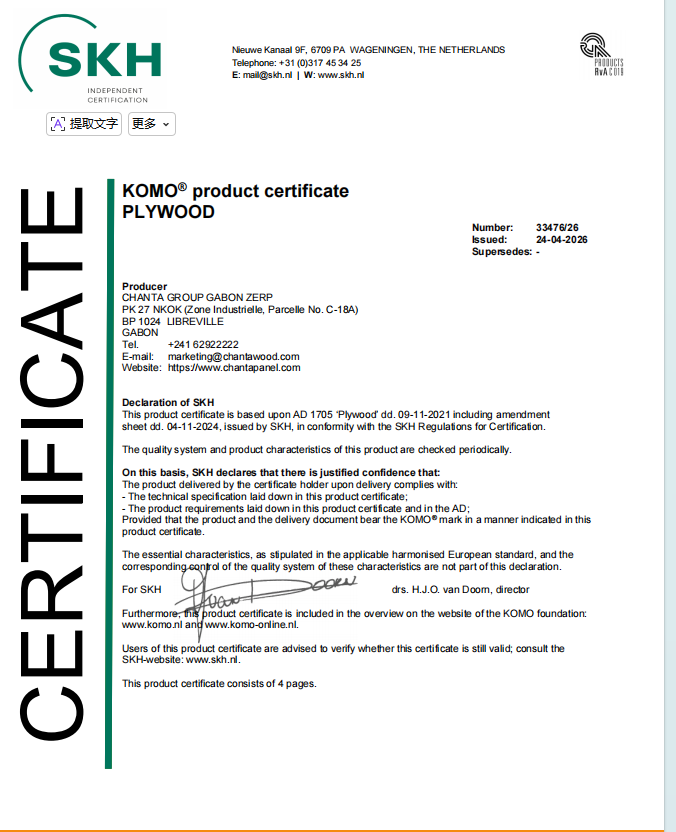
| Certification | FSC, CE, CARB, BS1088 |
What This Process Means for Buyers
Quality Starts at the Source
Every step, from raw material to final inspection, affects the performance of the plywood. Buyers who understand this process can better evaluate supplier capabilities.
Consistency Comes from Control
Factories that maintain strict control over peeling, drying, and pressing produce more consistent panels. This consistency is critical for bulk orders and large-scale projects.
Technology Makes the Difference
Modern equipment improves efficiency and reduces defects. Buyers should pay attention to factory capabilities rather than relying only on product descriptions.
Why Gabon Marine Plywood Stands Out Globally
Natural Material Advantage
Okoume wood provides a strong foundation for high-quality plywood.
Export-Oriented Manufacturing
Production often aligns with international standards, making it easier for buyers to meet regulatory requirements.
Balanced Performance
The final product offers a combination of strength, light weight, and workability that suits many applications.
Final Thoughts
The journey from forest to finished panel reveals why Gabon marine plywood continues to gain global recognition. It is not just a product, but the result of controlled processes, quality materials, and modern manufacturing.
For buyers, understanding this process provides a clear advantage. It allows better supplier selection, improved quality control, and more confident purchasing decisions.